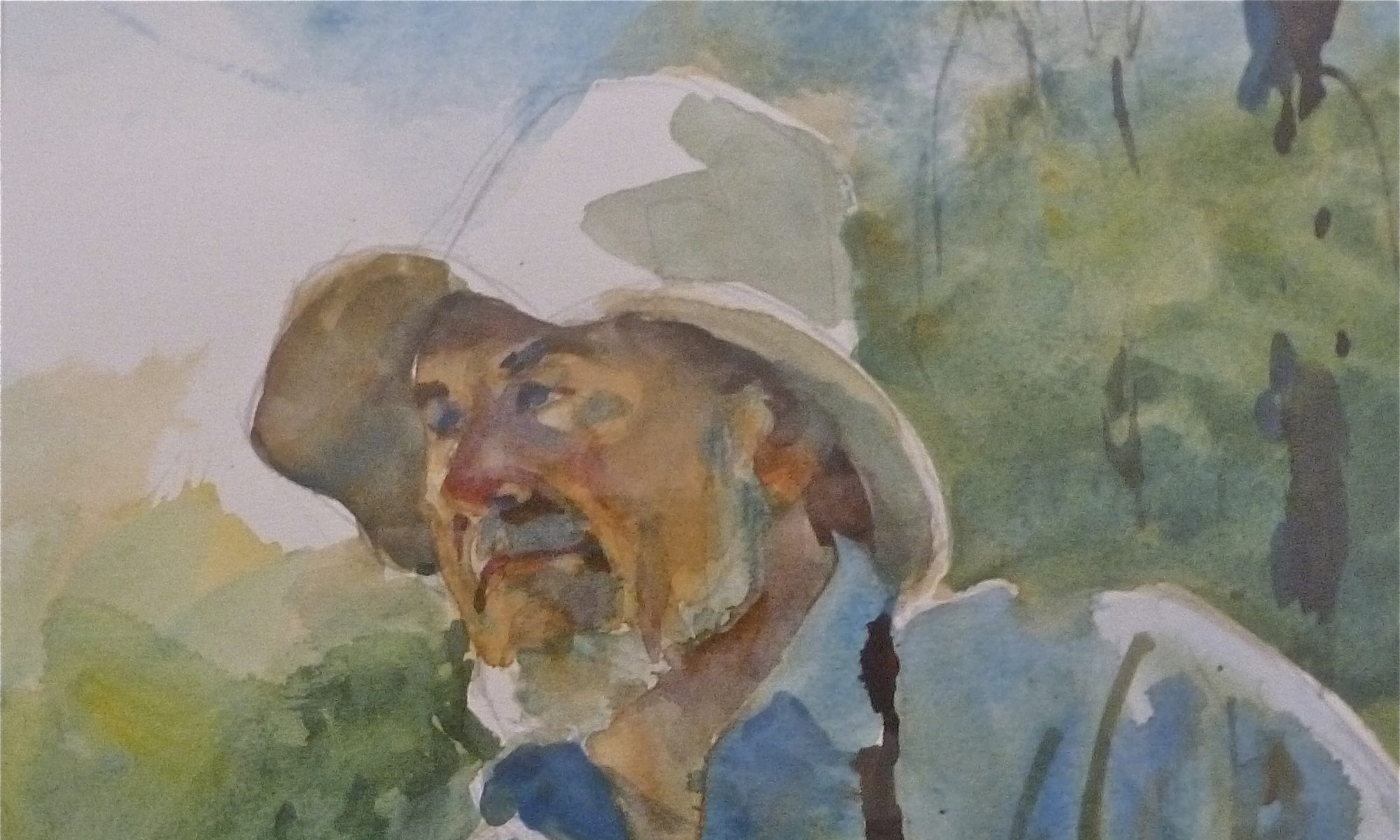
With all this turmoil within our country as well as around the world my mind races back to the ”Good Old Days”. Over 75 years ago ( Age 10) I seemed to be having the time of my life in spite of WWll raging in Europe & the South Pacific, our lives seemed to go on peacefully. Pine Island was a peaceful acre of isolation a few stone’s throw away.
Yes, many of you have read this before, but many new followers haven’t scrolled far enough back to enjoy my adventures of Island life.
In doing summertime things, time has not allowed me to write an adventure not yet published, so, I’m passing on to you again ” As I remember Pine Island”. Continue reading to clear your head for a few minutes. Ray.

As I remember Pine Island, looking west from Broad Creek, c. 1946. Sketch by Ray Freden.
Pine Island is a small island just off the shore of Seaview, between Warren Ave. and Seaview Ave.
It is about an acre with a horse shoe shape, the opening is on the south side and the high tide will flow into it making the center path impassable.
As I remember it, the south path was a dead end. The north path circled around the north end, turning east then south in front of four camps, all of which faced east toward Humarock. The largest camp was on the north end, its entrance facing south, with a screened-in porch on the east side. There were two more camps on the west leg; one was never finished. Getting to these camps was a chore for owners, campers and hunters.
The walkway to Pine Island as I remember.
c. 1946. Sketch by Ray Freden. 2013.
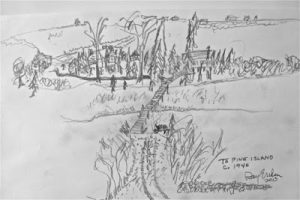
A deeply-rutted dirt cart path (now Warren Ave.) ran from Summer Street along the south side of two cornfields, and through a stone wall, turning north. At that turn was a cold clear spring with a wood cover and a chipped porcelain scoop for taking a drink or filling jugs for the campers. The path turned east to the edge of the marsh. There was a turnout for two cars. A long narrow wood walkway ran from the cart path to the west leg. The walkway was only wide enough for one person, and it was underwater at the high tides. The campers would have to carry everything across that walk, which was usually in need of repair. When the summer folks came for vacation, it took hours to unload gear and get it to the camp.
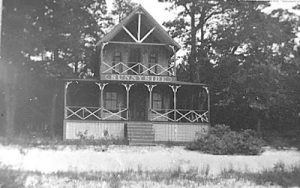

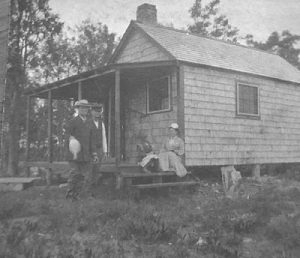
”Sunny Side” The only two story camp on Pine Island.
Compliments of the Larry Bonney family.
My first recollection of Pine Island was just before Thanksgiving; I was almost 5. Dad would go to the island to collect bay berries. He would cut them and my job was to carefully put them in a big basket. The island was covered with berries. He would carry the basket back across that rickety walkway; I carried the cutters. The car was parked in the turnout of the cart path.
Then he was off behind the turnout, through the brush, to the red berry bushes, I behind him carrying another basket — more clipping and very carefully stacking. Off we went with two big baskets on the back seat. A stop at the spring for a drink. Oh, was that water cold.
Dad would make bunches of berries and greens for Thanksgiving and Christmas decorations. A few years later, when I was allowed to go to the island alone, I collected berries and greens, and took over his job. I sold the bunches around the neighborhood and up to the end of Summer Street on my bike.
We once encountered hunters in the end camp. There was a sign over the door — it read something about being a hunting camp. My dad had a chat with them.
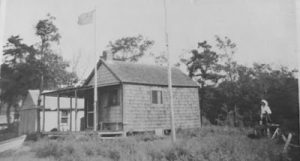
Compliments of the Larry Bonney family.
In the summer, two families from Lowell, MA came to vacation for most of the summer, they stayed in the north camp as well as the camp next to the pump.There were 5 kids, two were my age.
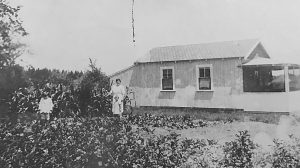
Compliments of the Larry Bonney family.
I would ride my bike down the cart path, over the walkway, around the north path; I would pass the outhouse, stop and lean my bike against the water pump. We were almost always in bathing suits and tee shirts, so off to the swimming hole we would go.
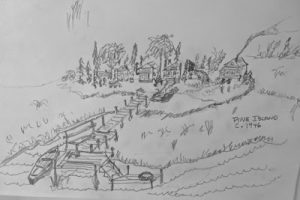
On the east side of Pine Island was a wooden walkway out to a leg of Broad Creek. At the edge of the creek were a dock, a ladder to a lower landing, and a diving board. The walkways and dock were built mostly from driftwood lumber scavenged from the marsh. The camps also were built from mostly salvaged lumber.
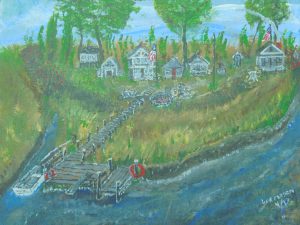 Painting added 4/2019
The walkway and dock from Pine Island to Broad creek.
Sketch by Ray Freden. 2013.
At low tide, I would have mud fights with the kids staying on the island. The older kids would grind the mud into us! Every inch was covered in black, slimy mud. Sometimes we would wait until the tide came in enough to wash off. Other times we would lay near the water pump while another pumped. It took a lot of pumping to clean up, & the water became colder the longer it was pumped. The pumped water on the Island was salty and discolored, used only for washing.
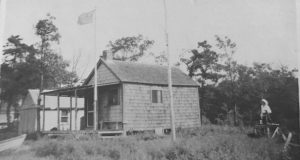
The water pump was located near this camp.
Compliments of the Larry Bonney family.
At mid to high tide, we would dive or jump from the board or off the railing. Full high tide would cover the dock and walkway, but only ankle deep. It was a challenge to ride my bike out to the dock, and a bigger challenge to ride back through the water.
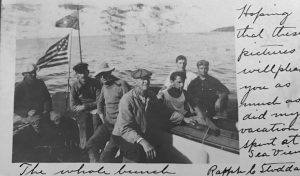
The men of the families returning from a fishing trip.
A postcard sent to Bill and Jo Bonney from Ralph Stoddard.
Compliments of the Larry Bonney family.
A dory was tied on the south side of the dock. The two men and two older boys would row out through Broad Creek to the clam flats at low tide, dig clams, then go fishing in the river. They would return as the tide came in, going with the tides. There were plenty of flounder, mackerel, cod and haddock in the mouth of the North and South Rivers.
Showing off a flounder.
Compliments of the Larry Bonney family.
The men would clean the fish on the dock. I was invited twice for a cookout. This would be the fish fry. I would help with the cooking fire in a stone circle. Plenty of kindling could be found above the high tide line and someone delivered firewood for the campers, by wheelbarrow!
There was a steel cook plate across half of the fireplace. The men filleted the flounder, the women rolled them in cornmeal, and three of us kids kept the fire going. On went the flounder, mackerel and hot dogs. Mmmm —-was that flounder good! I would have no part of mackerel! The haddock and cod were saved for fish chowder.
A cookout on Pine Island was suppertime for the camp people. The fire pit was either going or smoldering most of the time. (When it rained they would cook on the wood stove in the kitchen; it was unbearably hot.) I was invited the day before, so I begged my Mom to make oatmeal cookies.
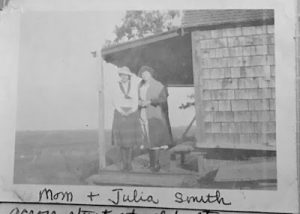
This ”Mom” was Mrs. Josephine Bonney and friend Julia Smith.
Compliments of the Larry Bonney family.
The next day, off I went down Station Street, turned down the Pine Island cart path, over the rickety wooden walkway, up the path to the camp, and gave the cookies to the Mrs. The kids were in the water on red inner tubes I had salvaged from the Seaview Garage. I ran down the walkway to the dock, off the diving board to cannonball the two in the tubes. The two older kids had left for the city, and good riddance! Now there were two of us the same age plus two younger, so we took over the tubes. We stayed in the water until we were blue.
Back to the camp, stashed the tubes under the porch and put wood on the fire pit to warm up. It was nearing their suppertime — they ate much earlier than I was used to, but this was a cookout to me.
All of the perishables were kept in a wood lined hole filled with water, with a cover with a large stone on top. Out came sodas and hot dogs. The dogs were all linked together and stayed that way on the cook plate over the fire pit. I remember how hot dogs always had to be cut on opposite sides to cook properly. These folks didn’t do this. They also put ketchup on their dogs — yuck, mustard only for me! We filled ourselves with dogs, orange soda and oatmeal cookies.
Just before dusk, out came the midges — they would cover you in a short time and we would have to pump water on our arm and legs to wash them off before we went inside. Inside, we, the kids, would play checkers on the porch, with a kerosene lamp on the table. The adults would play cards in the kitchen with one of those Coleman gas lanterns I so much wanted.
Summer came to an end. The folks from Lowell left. Fall came. The hunters arrived, hung their decoys on the side of their camp, and collected marsh grass to build a blind out near the dock. So many times I would hear their guns banging away early in the morning and again in the late afternoon. I thought to myself, ”Who would want to eat a wild duck?” It wasn’t until years later I found out how good a black duck is!
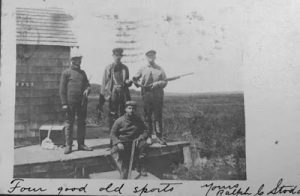
The next summer, only one family came to the island, with their younger kids, so my visits were short. I found hanging out in Humarock with my summer friends was a lot more fun, and jumping off the old bridge as well as the new one, the 1952 bridge was a lot higher.
Now I only went to Pine Island to collect berries in the fall. The camps were no longer used and began to fall apart rapidly. One late evening, I was driving home and there was quite a to do down Warren Ave. — police and fire engines with flashing lights down the end of the Pine Island cart path. I suspected the worst — the camps. I was told the next day that vandals had torched some of the camps! The others left standing were later torched.
I never went back to the island to witness the loss. I never saw my island friends again. My recent visits have been through the eyes of Google Earth. I have now witnessed Pine Island, after people!

Pine Island looking east, without people. Photo by Tony Lambert.
”There’s no place like camp, I wish I could stay forever.”
–Unknown.
by Ray Freden
Seaview, 70 years.
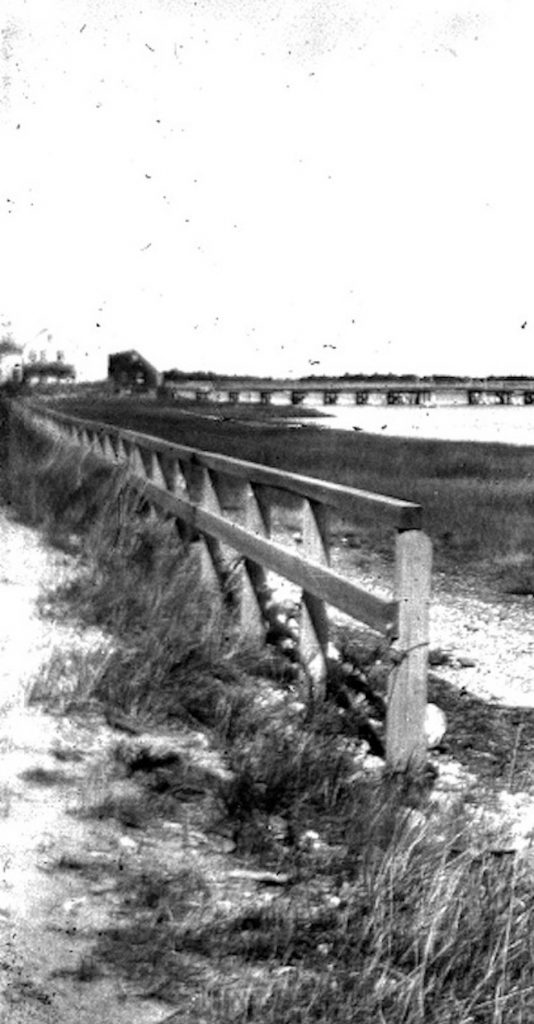

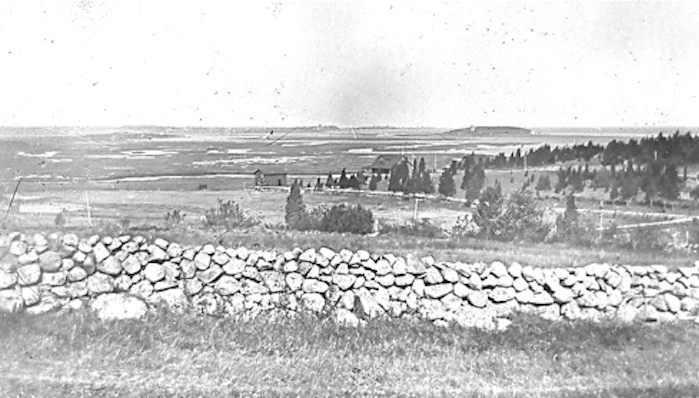
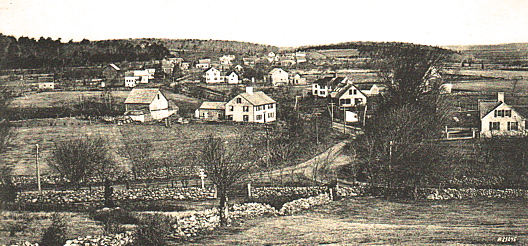
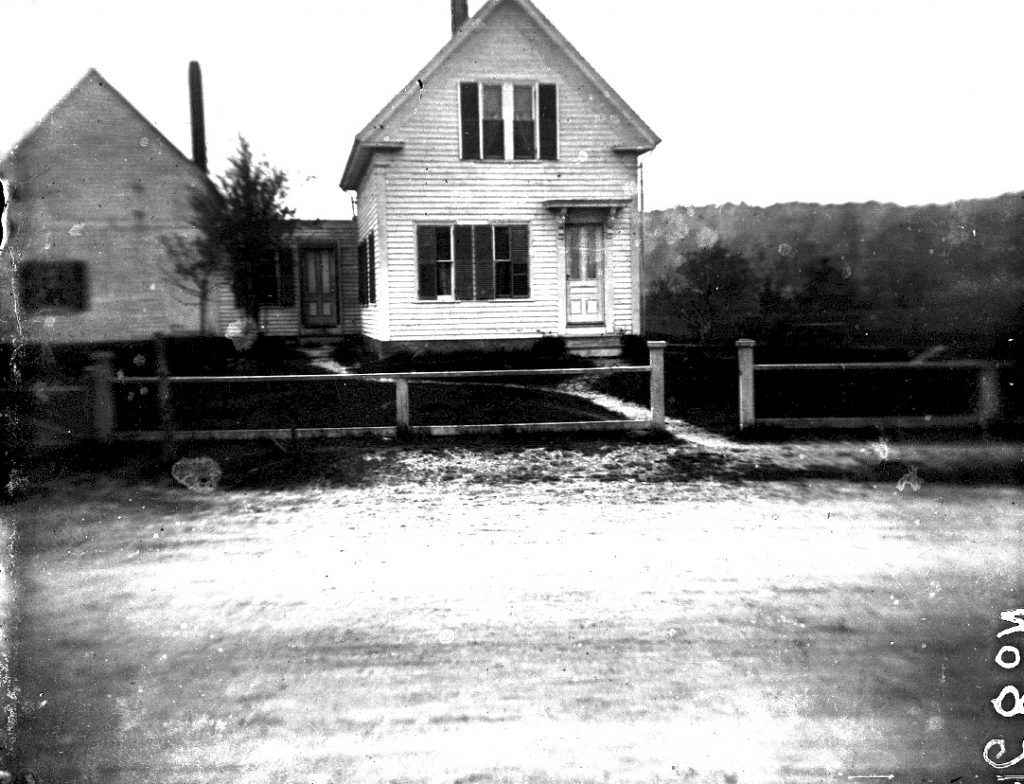
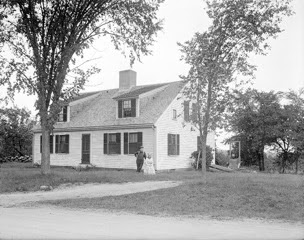 Photo taken about 1910.
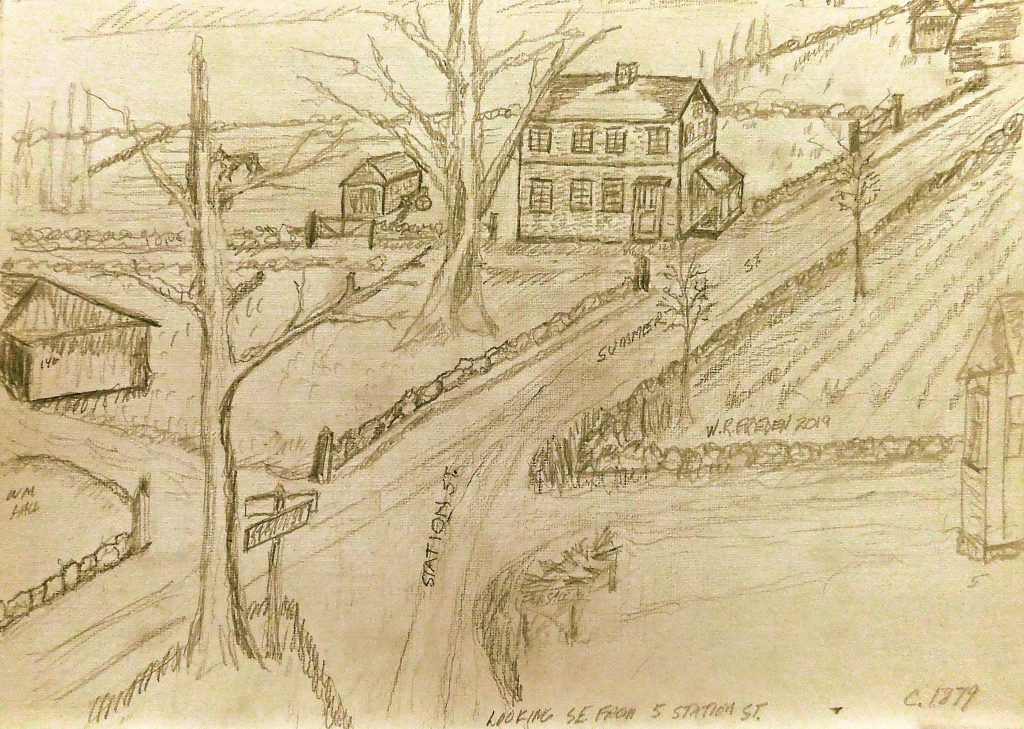 Sketch by W. Ray Freden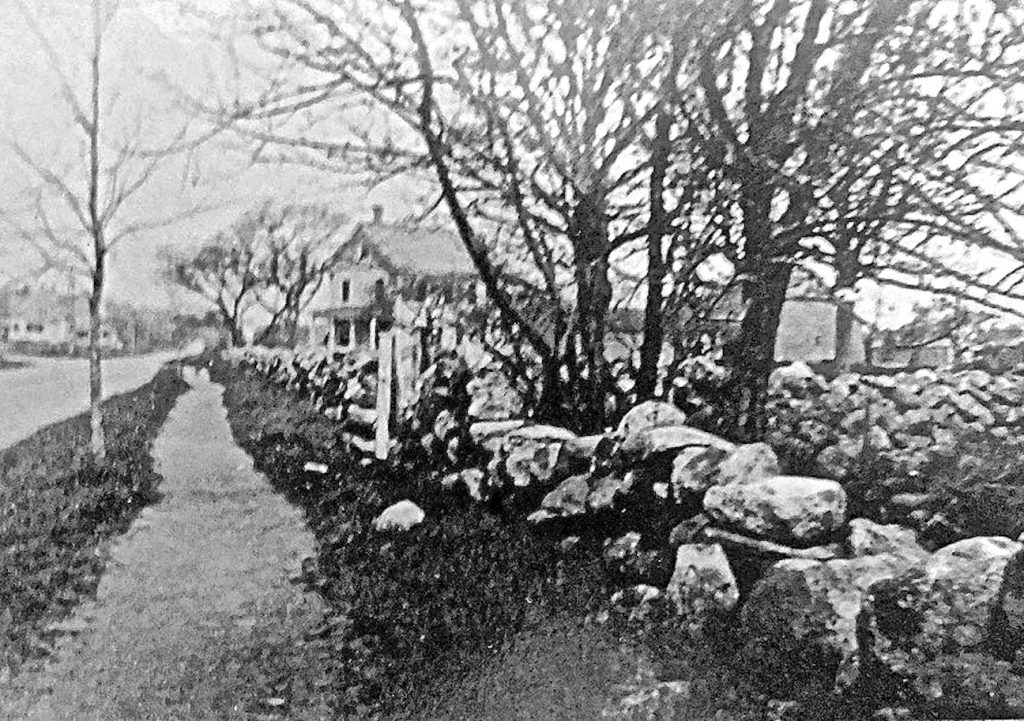
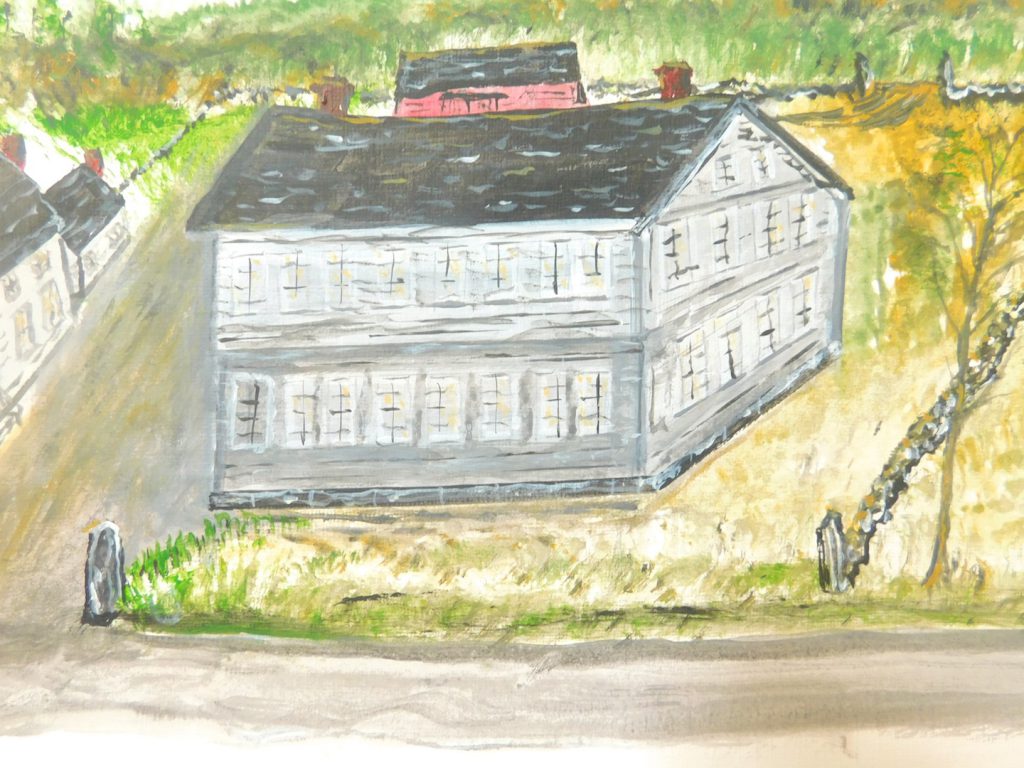
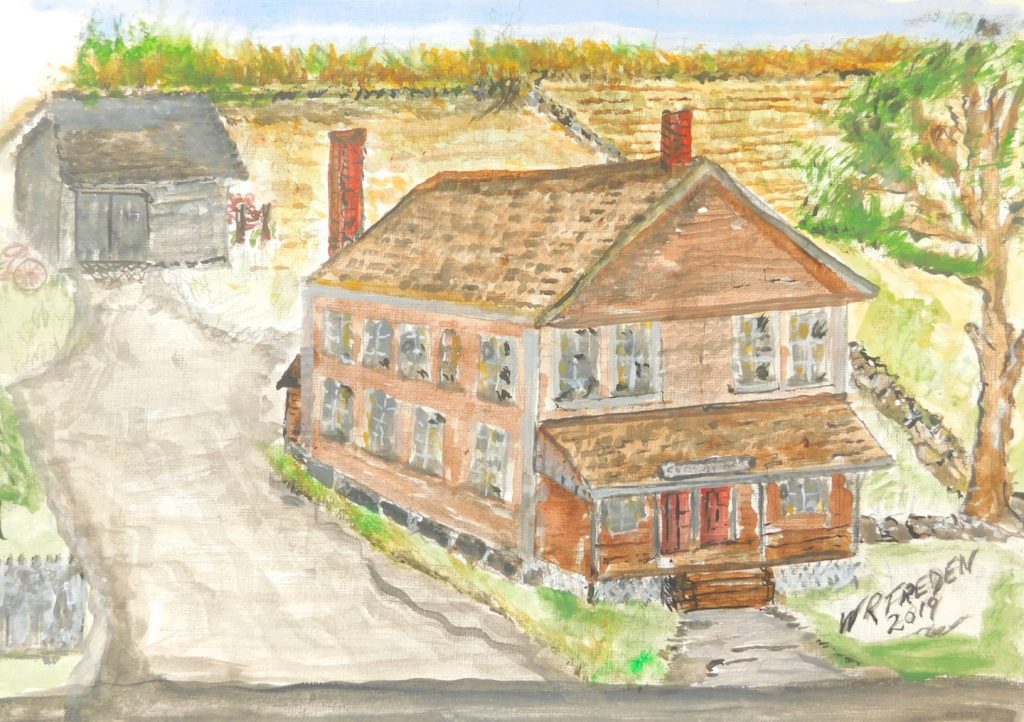 Paintings by W. Ray Freden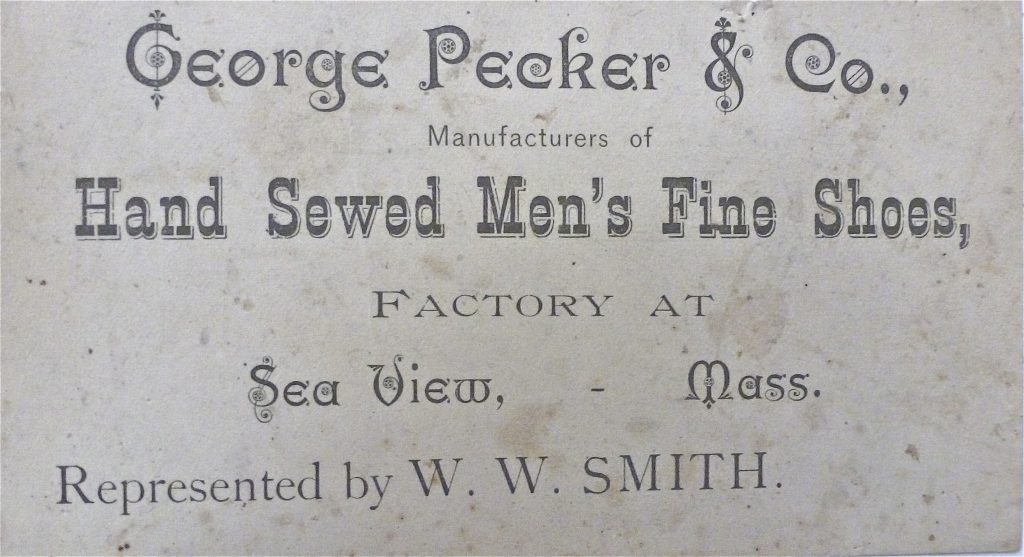
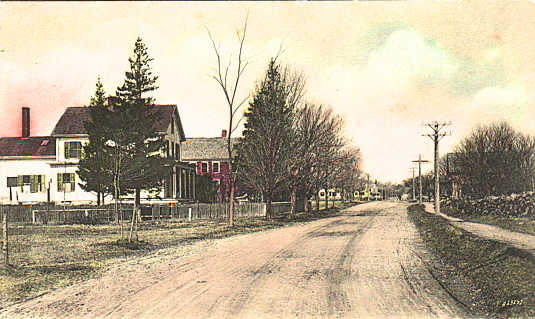
 Gasoline .07 ¢ @ gallon.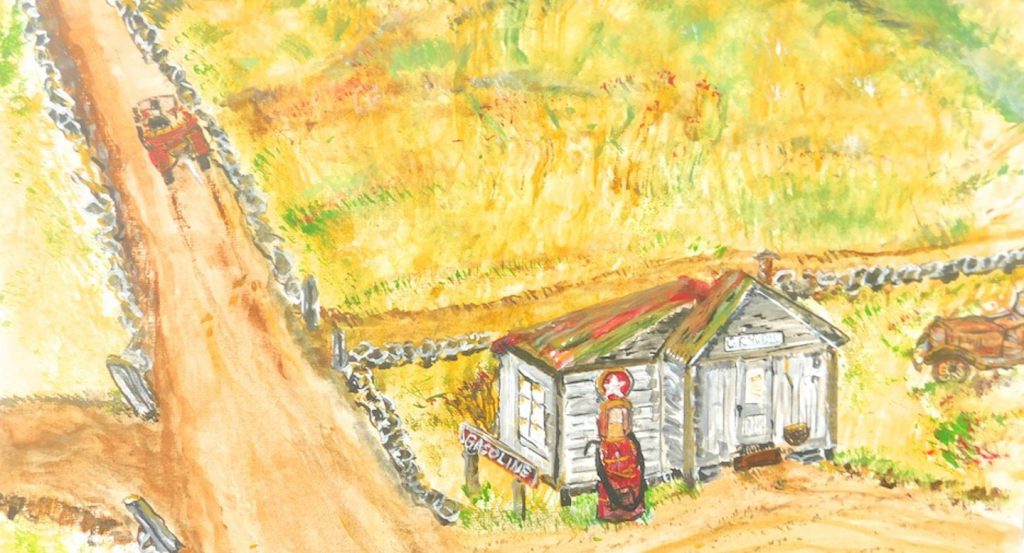
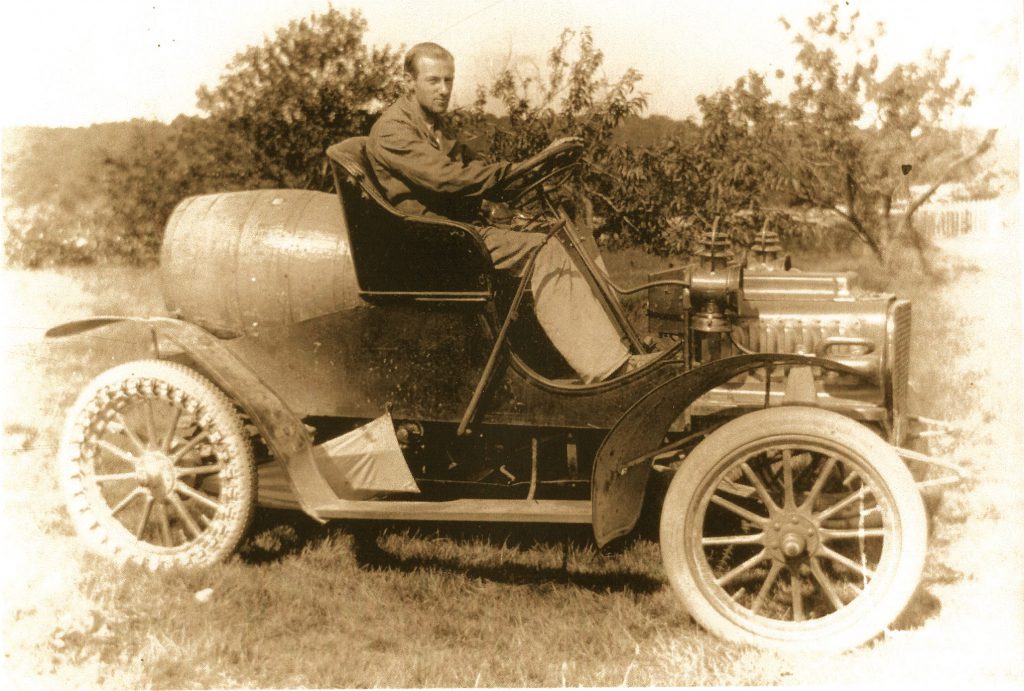 Charles (Charlie) Randall in his 1904 Rambler hauling gasoline to his Gas Station at 91 Summer St.