When I was young, Holly Hill was a mountain. It was a challenge from all sides. I think my first recollection on this mountain was peering out the windshield of my Dads old Chevy, stopped on top of Upland Road, looking at smoke billowing into the sky somewhere near Boston.
My Dad used Holly Hill as a testing ground for his old Chevy. He would do a tune up on it, then pile me into the old six cylinder, and off to the hill we’d go. Dad would make a left turn on Elm Street then a right on Upland Road. If the old Chevy made it to Dwight Road in third gear, it was a good tune up. If not, he would get his screwdriver out, make an adjustment on the points, and try again. This was an exciting adventure because we seemed to be flying around that hill! Also, we would usually end up at “Stead’s” for a bottle of Ballantine Ale (35 cents), a cigar (15 cents), and a candy bar for me (5 cents). Total, 55 cents. Life was good.
There were only four roads on Holly Hill — Upland, Dwight, Emery and Holly, with just a handful of houses. There was only one house on Upland Road, at the peak facing north, with a spectacular view of the North River, all the cliffs, and way beyond. The next best viewing point was at the peak of Emery Road, facing north. There were only two houses on the right side, The Chamberlains in the first, and the Stantons at the very top — a brick house.
At the south end of Emery there were two houses on the left side, both very large and very beautiful. Dwight Road had only one house (brick) at the corner of Holly Road. This part of Holly Road no longer exists, and Holly Road off Dwight did not exist –just a cart path that went to Ferry Street. Most of the homes were on Elm Street, starting from Holly Road to Ferry Street.
Now for a stranger, Holly Road can be confusing. It starts on Elm and dead ends. It used go though to Emery, across to Dwight, then stop. Now it runs south from Dwight, almost to Ferry Street. I spent many trips down this muddy cart path collecting holly with red berries.
by Ray Freden Originally published in the Marshfield Mariner, March 24, 2010
In the 1940s, Seaview had its share of truck farmers. Farmers had been growing crops since the beginning of Seaview’s settlement, but I only remember the 1940s and ’50s.
I was always told they were “truck farmers.” Most took their goods to the Boston market. I’ve also been told they were “market gardeners.” Well, have I been misinformed! Market gardeners? Truck farmers? I’m just going to call them what I had always been told, “truck farmers,” because I like TRUCKS! And anyway, before trucks there were wagons. Were they wagon farmers? Keep on trucking!
Saturday afternoons were special because after Dad finished his work around the yard, or tearing apart the old railroad station, he would be off to Stead’s for a quart of Ballantine Ale and a cigar. I could tag along with a return bottle to exchange for a candy bar: 30¢ for a quart of ale, 5¢ deposit, 15¢ for a cigar, and a candy bar with the 5¢ from last week’s bottle. Total expense: 50 cents. High rollers, huh?
My Dad’s favorite treat on a weekend afternoon.A quart of ale, 30¢.A 5¢ bottle return got me a candy bar.
On the way down, Dad would turn left on Elm Street. The next house on the left was the stately home of Victor Belanger, a beautiful home with a huge barn, another smaller barn, and many outbuildings. As we traveled farther, we came to Ferry Hill Road. Mr. Belanger’s land continued and included another large barn, now known as the YWCA. A small pond and a boathouse were nearby.
All of this, down to Little’s Creek, was known as “Belangerville.” From his home to the red barn (YWCA), the land was cultivated. I remember lots of corn in the fields. Mr. Belanger was a dapper man who did his business in Boston and was a gentleman farmer in Seaview.
A note from Bill Frugoli of Summer St.:
“My uncle, Louie Frugoli, would work on the Belanger farm, circa 1912, before going to Boston for winter work. He would come back occasionally for the Marshfield Fair.”
Thank you, Bill.
There were three fields of corn on the east side of Summer Street at a cart path to Pine Island, now known as Warren Ave. Before the war, Manuel DaLuz cared for these fields for Mrs. George Taylor, who owned large garden plots on both sides of Summer Street.
Manuel was drafted into the Army and was gone long enough for those fields to grow into weeds and brush. Farmland was becoming valuable after the war. In 1946, the first new home in Seaview was built in that cornfield at 146 Summer Street and Warren Ave. by a Mr. Sherman. Keep in mind, houses were not numbered in Seaview in the ’40s.
Gathering corn
As we continued up Summer Street and turned left onto Pleasant Street, we passed under the railroad bridge and by Gino Rugani’s Sterling trucks. Gino was the largest general contractor in Marshfield.
At the top of the hill, the street turned sharply right. Shortly afterward, on the left, was the Salvetti farm. Fields of tomatoes ran from the street up the hill and past their farmhouse and barn. Peter Salvetti was a mason by trade and also farmed his land to sell produce at the market—a truck farmer. His son Sergio still farms a plot of land atop the hill. Peter’s other son, Aldo, also farms a small plot atop the hill behind the homestead.
Next came another field of tomatoes, up the hill to the Cervellis’. Mr. Frank Cervelli was the largest tomato grower around. There were large fields past Eames Way full of tomato plants, strung to wire supported by posts at each end.
Mr. Cervelli had a large processing operation off Pleasant Street. Crates of tomatoes would arrive to be culled, washed, polished, and packed for the Boston market. His truck would be stacked to the top of the boards, tied down and covered with canvas, ready for an early trip to the Boston market. I could never get enough of those big, juicy, sweet tomatoes.
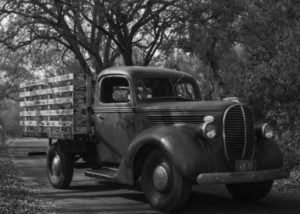
I don’t know how this 1935–36 Ford made it to the Boston market one or two times a day, overloaded!
The largest truck farmer in Seaview during the ’40s and ’50s was James Gonsalves, “Jimmy,” from Moraine Street. He rented the fields from Miss Donovan of 101 Summer Street and Mrs. Lucy Taylor of 119 Summer Street. There were more than 10 acres surrounded by the wonderful stone walls known so well here in New England.
These walls were used to keep livestock in—or out—and also to mark owners’ boundaries. Where could all those stones, rocks, and boulders have come from? And how did they get them to the wall?
Imagine a boulder of 200 pounds or more, sunken into the ground and in the way of the plow. You had to dig around it so you could wrap a chain around it, then have your team of horses or oxen pull it out! Then what? Pry-bar it onto a skid or scoop, haul it to the wall area, then pry it off and into position. The next time you look at a stone wall, think how you would feel at the end of that day’s work!
In the largest field, corn harvesting was done by pickers walking down a row, filling a sack, then dragging it to the edge of the field, where the top of the sack was sewn tight before it was loaded onto the truck.
The large field was often used for cabbage and sometimes lettuce, but quite often for cauliflower. This harvest was the most complex to me. Just after the heads formed, workers would tie the outer leaves of the cauliflower with an elastic band so the heads would blanch and form uniformly. I had always thought they did this to keep the worms out! They kept the worms away by filling a sack with DDT, then walking down the rows and giving the sack a slight shake over each plant.
When harvest time came, hundreds of wooden bushel boxes were stacked in the northeast corner, along with a few tables and stools or chairs with the backs broken off. The cauliflower plants were cut from their stems, tossed into a horse-drawn wagon, then brought over to the corner where the cutters, usually ladies, chopped off the tops.
They would hold the plant by its bottom, then slice the leaves off as close to the head as possible—a very precise task! As they sat around going about their business, they would chat in Cape Verdean and sometimes English, always laughing.
When the trimmed heads piled up, they would stuff a box with waste leaves, then place the heads upright until the box was full—I think five or six heads—then cover them with leaves. The boxes were stacked along the edge of the field, awaiting the truck.
The smells were awesome (I don’t think that word was invented in the ’40s): fresh-cut cauliflower, new pine boxes, and the smell of the pine grove across the tracks.
The boxes were made from box boards from the Hatch Mill on Union Street. Many also came from the Gib West Box Mill in Pembroke. Part of the building is still there, as well as the Hatch Mill.
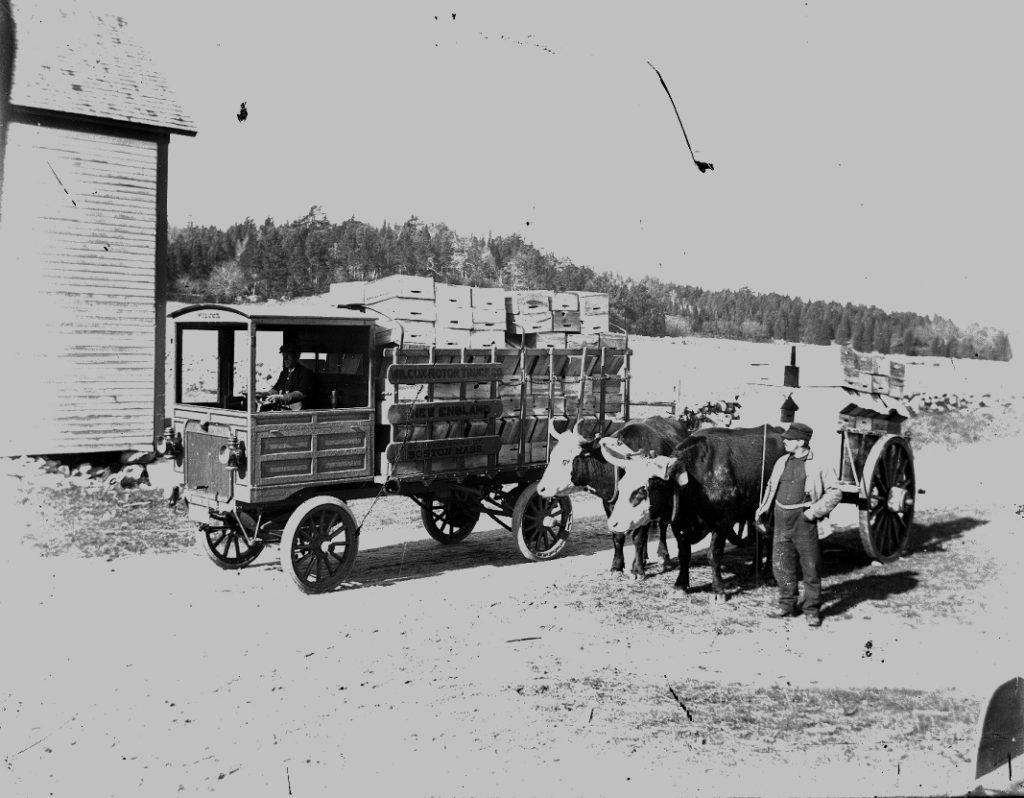
1918 Wilcox Motor Truck. A 1918 Wilcox Motor Truck and team of oxen loaded with empty wooden boxes, ready to pick up cauliflower off Summer St. in Seaview, c. 1930.
Jimmy’s truck would arrive late in the afternoon to be loaded by the crew. Off came the stake side and back, then the loading began. Two men on the truck did the stacking, with the ladies passing up the boxes until they reached the top rail. The boxes were then covered with canvas to keep out the sun and dirt.
There were always culls left aside, so I would help myself. This applied to corn, squash, cabbage, and lettuce.
Another truck farmer was Manuel DaLuz. I first remember Manuel living in a barn on the corner of Summer Street and Warren Ave. Before the war, as I remember, the fields along Warren Ave. were full of corn. Manuel was drafted into the Army and the fields went unattended. After the war, the lot was sold and a large home was built in the cornfield.
Manuel’s 1939 Ford Truck.
After Manuel returned from the Army, he began growing strawberries. A huge field of berries grew beside his house. If Manuel ever thought he was having a bad strawberry crop, it wasn’t because of the robins or the weather. It was because of two young teenage birds camping out near the strawberry patch.
My summer friend would arrive for the summer, and we looked forward to our campouts, sometimes in my yard and other times in his. One afternoon, we planned a campout for that night. We got permission from our parents and gathered our gear—a tent, ground cloth, sleeping bags, lantern, comics, flashlight, drinks, and snacks. Oh yeah, and a jar with a cover full of holes.
After we set up the tent in a grove of locust trees at his house, we killed time in the early evening playing ball, swapping comics, and catching fireflies to use as a night-light in the tent. Yes, it worked! Our plan for later was to raid Manuel’s strawberry patch just across the meadow.
Around 10 o’clock, we quietly and quickly ran across the meadow, hunched low, to the cart path, over the stone wall, and onto the huge patch of big, red, juicy berries. We stayed on the outside row so we wouldn’t crawl over and crush any berries.
Now, the trick was to feel a berry and slightly push your thumbnail into it to test its ripeness. Then you’d pluck the big, juicy, ripe ones and munch ’em down, one after another, and another, and . . . Another trick was to bury the bitten-off stem with the other thumb—we didn’t want to leave any evidence of leftovers from the nighttime raiders!
About 15 minutes into our raid, we were scared to hell by the arrival of my dog, Lucky. Yep, he came bouncing up behind us, tail a-wagging and happily whining. OH S—!!!
You see, Lucky was an English setter, mostly white, and stood out like a neon sign! Not very good for us! Now, with both of us on our hands and knees, Lucky thought we were playing with him and started barking!
We had to get the hell out of there, so we scrambled on our hands and knees down the row, and Lucky ran with us, barking and nipping at our ankles. We got to the stone wall and cart path, then ran full speed across the meadow and into the tent, dog and all.
My friend was laughing like hell, but I saw no humor in our past few minutes! I was shaking. Who might have seen us? Who heard Lucky barking?
Needless to say, we didn’t sleep that night, waiting for the Berry Police—or even Manuel. My Dad didn’t know that I had asked Mom to keep Lucky on the porch that night, and he let him out when he went to bed. Lucky was the only happy camper that night! We never again raided Manuel’s strawberry patch.
Hiding in my tent from the “Berry Police!”
By Ray Freden
Originally published in the Marshfield Mariner, June 10 through July 29, 2009.
When I was a teen, on a cold weekend, kids and adults would gather on Keene’s Pond to play hockey or just to skate. Franklin O’Donnell had a cart with an attached cabinet, the doors and shelves of which were stocked with candy bars, cheese crackers, Devil Dogs, Whoopie Pies and other stuff, all frozen. Frankie would haul his cart onto the ice to peddle his wares. A 5-cent Milky Way was 10 cents — everything was marked up 5 or 10 cents over Sted’s prices. Stedmans, the store on the corner of Ferry Street and Sea Street, was also known as the Seaview Package Store.
Some nights, folks would come back to skate. Many times a bonfire would be made and we would cook marshmallows and sometimes hot dogs. The stick you would cook with was never long enough, and you would nearly cook your legs!
Ice blocks were sold by the pound.
Mom would display the pounds she wanted
at the top, in the porch door window.
“Dirty Russ” Williamson delivered ice to the neighborhood for Horace Keene. Russ stopped his truck on Station Street, under the overhang of a big maple tree (long gone). He would honk, then holler, “Ruthie, how much ice ya want?” Mom would have a sign in the porch window with the amount above. I never understood why Russ had to ask — maybe Russ couldn’t read or see? Anyway, Mom would holler back the amount, Russ would uncover a block then stab lines across with an ice pick. A small block would fall off. Then he would grab it with tongs and toss it into the scale, trim it, and put on his leather apron, which hung down front and back. Russ grabbed the block with tongs, lugged it into the back hall, then fitted it into the icebox. How did he know what size to cut a 50# block? There was always a chip of ice left near the tailgate that I helped myself to, standing barefoot in a pool of ice water that drained from the ice truck (summertime only).
A block of ice headed to our icebox.
In 1945, Horace Keene was no longer cutting ice. I think My Dad bought ice in Greenbush and hauled a block home, set onto the front bumper of his Chevy. Within a short time we got a refrigerator.
The icebox.
Horace Keene’s helpers cutting ice. looking W. Courtesy of H.C. Keene’s grandson Tony Lambert.
” H. C. Keene” Sea View Mass. icepick.
Courtesy of H. C. Keene’s grandson, Tony Lambert.
Horace Keene’s Ice House looking NE. Courtesy of H.C. Keene’s grandson Tony Lambert.
Horace Keene’s ice house under construction. looking SE.
As the years went by, I watched Keene’s ice house, on Church Street, become a derelict — first sagging, then a wall crumbling, and one day in the mid-to-late 50s, it came tumbling down upon itself, spewing sawdust out its walls in big heaps all around. It remained a heap of rubble for a few more years. A house has been built forward of where the icehouse stood.
I never knew who owned Keene’s Pond. I suspect it was named for its abutter, Keene, on the south side, however there were other abutters on the east, north and west. The late Seaview historian, Philip Randall, told me that the pond was also called Little’s Pond, Randall’s Pond and maybe Seaview Pond. I wonder what folks call it now.
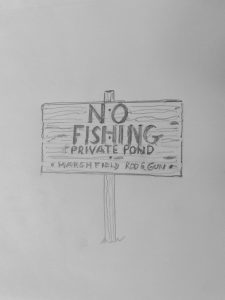
Just another remembrance: In the spring, after ice-out, Charles “Simmy” Simmons and Fred Hall, members of the Marshfield Rod & Gun Club, would replace the NO FISHING sign on the pond, about 50 feet out from Summer Street. It seems the pond was privately owned, and the R&C stocked it with rainbow trout. I never did catch one of those babies! And the sign and post usually helped cook marshmallows!
by Ray Freden
Originally published in the Marshfield Mariner, March 25, 2009