
SC 241 – The Mysterious Wreck in the Hanover Flats

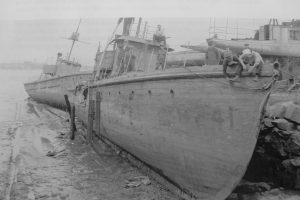
The SC 241 being scrapped 

As long as I can remember, I was mystified by the boat or ship atop the marsh in ”The Hanover Flats,”  on the South River .  Sometimes during the summer, at night, my Dad, Mom and I would take a ride to Humarock and up to the cliff. As we passed Hatch’s Boat Yard, the dim shadow of the boat would appear out atop of the marsh, with  dim lights  showing thru the windows.

My Dad said it was once a Rum-runner — oh wow, more mystery! Dad told me it was there before he arrived in 1927. Dad worked for Charlie Clark of Clark’s Store in the early ’30s and said that the people who lived in the boathouse on the flats would come to the store for groceries during the summer — but he didn’t know their names or where they came from.

During the summer, two or three dories or skiffs would be tied to the rear porch built on the back (stern) of the boat. A large square box-like structure was built in the middle, like living quarters. A line of windows could be seen from Central Ave. There was a tall flagpole near the center. I remember it as being grey natural wood with little paint.


A few of the Humarock kids that had boats would go aboard in the fall or spring, when no one was there, and tell stories about the skeletons seen inside. Not true, but it made even a greater mystery! Oh, how I wanted to go aboard and see for myself. I never did.

There have always seemed to be conflicting stories about the history of the mysterious wreck on the Hanover Flats in the South River, between Humarock and Branch Creek, which is south of Trouants Island. In Edward Rowe Snow’s story about the Submarine Chaser S-241, published in the Patriot Ledger on 12/11/67, he wrote, “First I was informed that the craft was a rum runner which was trapped during prohibition days under heavy gunfire at half tide on Hanover Flats, after which it was abandoned.” I really like that part — my Dad told me many stories of the rum running days in Humarock.

Snow goes on, “Then I was told it was not a rum runner but a rum chaser which, after a successful career, ended her days on the edge of the North River and went ashore at the Hanover Flats in a gale. This story was objected to by a prominent resident of the area who told me that it was neither a rum runner nor a rum chaser but actually a submarine chaser which had been converted into a Rum runner during prohibition and operated in the Marshfield-Scituate area for three years, during which time its owner buried hundreds of cases of liquor at various places on the marsh, two of which I was taken to. Surely enough, it did appear as though something had been placed there at some time.”

Snow continues, “My informant also assured me that there were still scores of bottles which had been hastily pushed into the soft ooze in the area and were still there. As to whether  the contents were useable , he did not offer any comment.”

These are the same stories I heard from Seaview and Humarock residents in the ’40s. I will have more about buried “hooch” later. Many times I passed the remains of the mysterious wreck to go clamming in the area. The ribs stuck up maybe three feet with some planking still attached. One shaft lay in the middle for years. Not until 1967 did I learn the much more accurate story about the SC 241 from the Edward Rowe Snow article.

Peeking through the remains of the SC 241 Submarine Chase
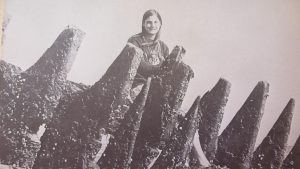
                                                               Dolly Snow Bicknell                                                                                                                                  

A total of 447 SCs were built. The New York Launch and Engine Company at Morris Heights, New York built the SC 241 in 1918. Commissioned April 8 1918, and captained by Ensign Robert L. Mills, she was 110 feet long, beam 14’9”, and draft 5’8′. Her speed was 18 knots, powered by 3three 220 hp gasoline engines, with three props, endurance 1000 n.m. Her armament included a 3” gun, two 30 cal. machine guns and one Y gun.

The origin of the Submarine Chaser (SC) traces back to World War I and the SC-1 class, wooden hulled, “Splinter Fleet.” The SC was designed for off shore patrols and anti-submarine warfare.

The SC 241 left New London, Connecticut, on May 13,1918, after being outfitted with submarine detectors and wireless telephones. She arrived in Halifax, Nova Scotia, five days later. On July 11, 1918, in the company of SC 247, she sighted a U-boat on her starboard side in a thick fog. At 3:40 p.m., she sighted a torpedo heading for a freight ship, which managed to avoid the torpedo. Pursuing the U-boat, she was able to get less than 35 yards away and then fired depth charges from the “Y” gun. One charge landed 10 yards in front of the periscope, which immediately disappeared. Five seconds later, a terrific explosion followed.
It is not known whether the U-boat she destroyed was ever identified.

After the war, the SC 241 was struck from the naval registry. She was sold for scrap on May 11, 1921, to the C.P. Comerford Co. of Lowell, Massachusetts, and stripped of guns, engines and all hardware. Sometime later she was sold to a John F. Smith, and towed by a tug to the South River, where she was then anchored. The Smith family painted the interior in various colors. The SC 241 came with a pilot house and a crow’s nest.

The SC 241 as I remember it c. mid 40’s by  W. Ray Freden  2019.
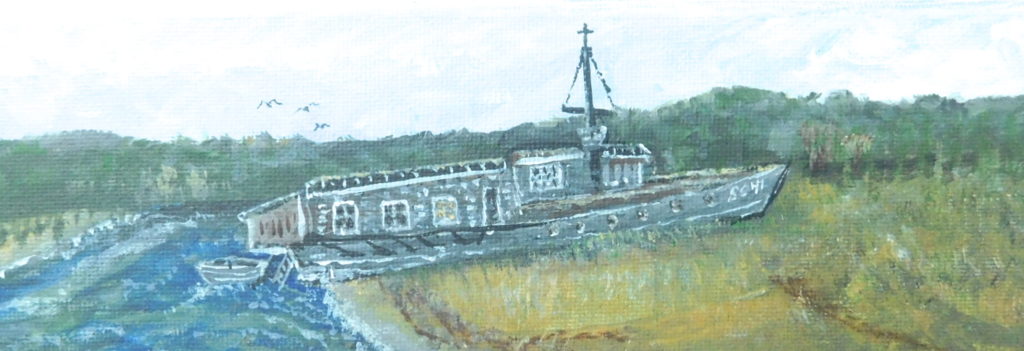
A storm in November 1925 caused the SC 241 to break away from her mooring. Blown across the marsh, she became stranded on the Hanover Flats. The Smith family dug a trench in the marsh and settled the sub-chaser into the south side of the flats. The family added a five-room structure, a rear porch, and a landing on the stern, which faced south. The family used the SC 241 as a summer home for many years.


  The SC 241 with a  six room living structure built atop by the Smith Family in the mid ’20’s.

Photo, collection of Janet Fairbanks.

During World War II, the history-making SC 241 was used less, and without care, began to deteriorate. Torched by vandals, she burned to the water line as fire companies watched helplessly from Central Ave. in Humarock. I never heard that anyone was charged with the arson.

On Monday July 1, 1968, the 50th. anniversary of the SC 241’s proudest moments, a small group from the Massachusetts Marine Historical League visited what remained of the craft out on the Hanover Flats. After a brief ceremony the members paid their respects to the crew of the SC 241 who had achieved fame half a century before, out on the rough waters of the North Atlantic when they sent a German Submarine to the bottom.
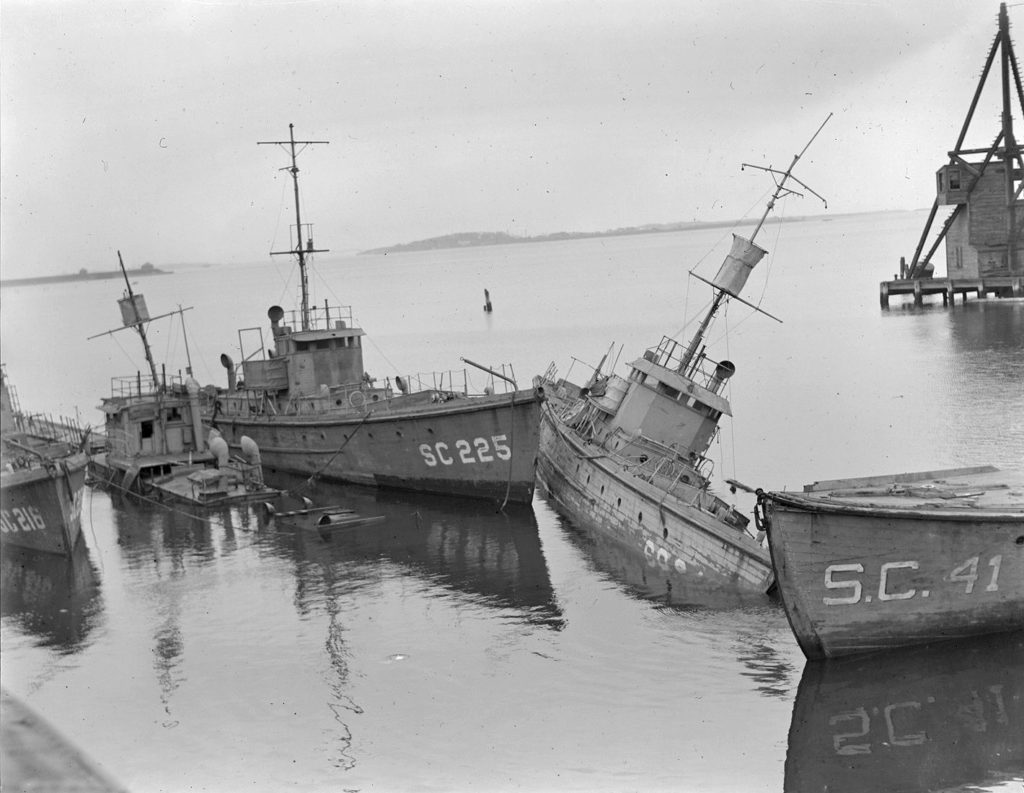
S.C.’s  wasting away in Dorchester Bay. c. 1920’s


”We are tied to the ocean. And when we go back to the sea, whether it is to sail or to watch-we are going back to whence we came .”       John F. Kennedy

W. Ray Freden Seaview/ Marshfield, 70 years.


Note: Much of this information came from Edward Rowe Snows “Sea and Shore Gleanings, “ published in The Patriot Ledger on 12/11/67. The coordinates are 42º 09′ 10. 88” N x 70º 42′ 21. 81” W. These are very close to the site were the SC 241 once was.


Springtime in Seaview/Dirty Joe

Joe Bradley harvesting hay off Corn Hill Lane.

About this time of the year (April) my Dad would start thinking about gardening. He would drive in the four stakes that marked the plot. On a Sunday morning before noon, he would pile me in his old Chevy and off to Cornhill Lane.

As we approached a turn in the road, he would pull off to the side and stop. We’d get out and go down a cart path to what looked a one-room shack near the edge of the North River Marsh. Across from the shack was a shed that housed a horse. Around both buildings were horse-drawn implements — a cutter bar, a hay rake, a harrow, and all sorts of wagons in all sorts of condition.

My Dad would knock on the door and in a few seconds a man would appear, dressed in long johns that appeared to have never been washed! This was Dirty Joe — Joe Bradly. Joe plowed gardens, and did other farm chores, so my Dad would arrange a time to have him plow our garden. As they made plans, I would climb aboard anything that had a seat and imagine I was driving it. Joe would holler over to me, “Sonny, you be careful on that. You might git hurt.” I would reply, ”OK!” Joe had a different accent than I had heard before.

A week before Memorial Day, ‘Dirty Joe’ would show up about 7 AM aboard his wagon, with a plow and harrow tied down. The noises would wake me, and I would rush to get dressed and out to watch him unload. He would block the wagon wheels, then unhitch his horse, tie a chain onto the plow, hook it to his horse, and drag it down the ramps.

The harrow was a different story — it could roll down out of control. He would drag it to the top of the ramp, tie a rope to it, then wrap the rope to a stake up front, give the harrow a tug, and it came rolling down the ramp as he slacked the rope. These tricks amazed this young kid!

By now my Mom would be out with coffee and a muffin for Joe, milk and a muffin for me. I would sit in the wagon seat and Joe would eat off the tailgate. I have no idea what we talked about — mostly my questions about the wagon stuff, I think.

He would hook up the plow, let it lie on its side, then signal his horse with a “click-click” with his tongue and cheek, and off the horse would go to the plot. Once there, he would lift the plow, point it into the soil, ”click-click” and off the horse would go. It was so amazing to see that soil turn. My Dad would say, ”with just one horse power.”

After Joe finished plowing our garden, he would drag the plow over to the next neighbor to be plowed. At noon Joe would come back to feed and water his horse. I was the water boy. The horse could suck up about half the bucket a time. Remember, I was just a small kid, and dragging a full bucket was a chore. A canvas feed bucket was hooked over the horse’s mouth and he would chomp away.

My Mom would come out with sandwiches and tea for Joe, milk for me – I on the wagon seat and Joe on the tailgate. Joe had a brown bag but never opened it. The bag looked as it had been used a hundred times. My Mom always topped off lunch with dessert — cookies, brownies, or a piece of pie. Joe would finish off anything left.

Now ”Dirty Joe” would climb onto the wagon, lie down on a rug, cover himself with a robe, and take a nap. His horse stood by waiting.

Next came the harrow — down the rows then up, then across until smooth. All for four dollars!

At about 4 PM, Joe would return to his wagon, arrange his implements, and get permission to leave them overnight (I loved that). Then he would take off the harness, put it in the wagon, mount the horse from the wagon, and off to Cornhill Lane from Seaview.

The story I heard is that he came from a well-to-do-family and graduated from Harvard. He had a Boston accent, a quick smile, and a mouthful of gold teeth. He was very polite, very well spoken, and my Mom once said, ”He had a twinkle in his eye!” He was always dressed in black trousers with suspenders, black jacket, not very white shirt, black shoes and a black hat. Is there anyone out there that remembers ‘Dirty Joe?”

by Ray Freden
Originally published in the Marshfield Mariner, May 19, 2010

Up-date 1/2020.

Bradley, Joseph H (1878-1952) – Marshfield Farmer 1935-1952 on Cornhill Avenue.

The 1940 Census for Marshfield shows that Joseph H. Bradley was a sixty-three years old, single male, who was born in New York, renting a farm on Cornhill Avenue on which he conducted his own farming business. He was the second to the youngest child and second son of Michael & Jane Bradley of New York City, New York, who immigrated from Ireland to the US. His siblings were George (b. 1867), Mary (b.1868), Kate (b.1875) and Elizabeth (b.1879). What could have brought him out here to take up farming in Marshfield?

Holly Hill

When I was young, Holly Hill was a mountain. It was a challenge from all sides. I think my first recollection on this mountain was peering out the windshield of my Dads old Chevy, stopped on top of Upland Road, looking at smoke billowing into the sky somewhere near Boston.

My Dad used Holly Hill as a testing ground for his old Chevy. He would do a tune up on it, then pile me into the old six cylinder, and off to the hill we’d go. Dad would make a left turn on Elm Street then a right on Upland Road. If the old Chevy made it to Dwight Road in third gear, it was a good tune up. If not, he would get his screwdriver out, make an adjustment on the points, and try again. This was an exciting adventure because we seemed to be flying around that hill! Also, we would usually end up at “Stead’s” for a bottle of Ballantine Ale (35 cents), a cigar (15 cents), and a candy bar for me (5 cents). Total, 55 cents. Life was good.

There were only four roads on Holly Hill — Upland, Dwight, Emery and Holly, with just a handful of houses. There was only one house on Upland Road, at the peak facing north, with a spectacular view of the North River, all the cliffs, and way beyond. The next best viewing point was at the peak of Emery Road, facing north. There were only two houses on the right side, The Chamberlains in the first, and the Stantons at the very top — a brick house.

At the south end of Emery there were two houses on the left side, both very large and very beautiful. Dwight Road had only one house (brick) at the corner of Holly Road. This part of Holly Road no longer exists, and Holly Road off Dwight did not exist –just a cart path that went to Ferry Street. Most of the homes were on Elm Street, starting from Holly Road to Ferry Street.

Now for a stranger, Holly Road can be confusing. It starts on Elm and dead ends. It used go though to Emery, across to Dwight, then stop. Now it runs south from Dwight, almost to Ferry Street. I spent many trips down this muddy cart path collecting holly with red berries.

by Ray Freden
Originally published in the Marshfield Mariner, March 24, 2010